

History
From the Travancore Craft Economy to a Modern Art College.
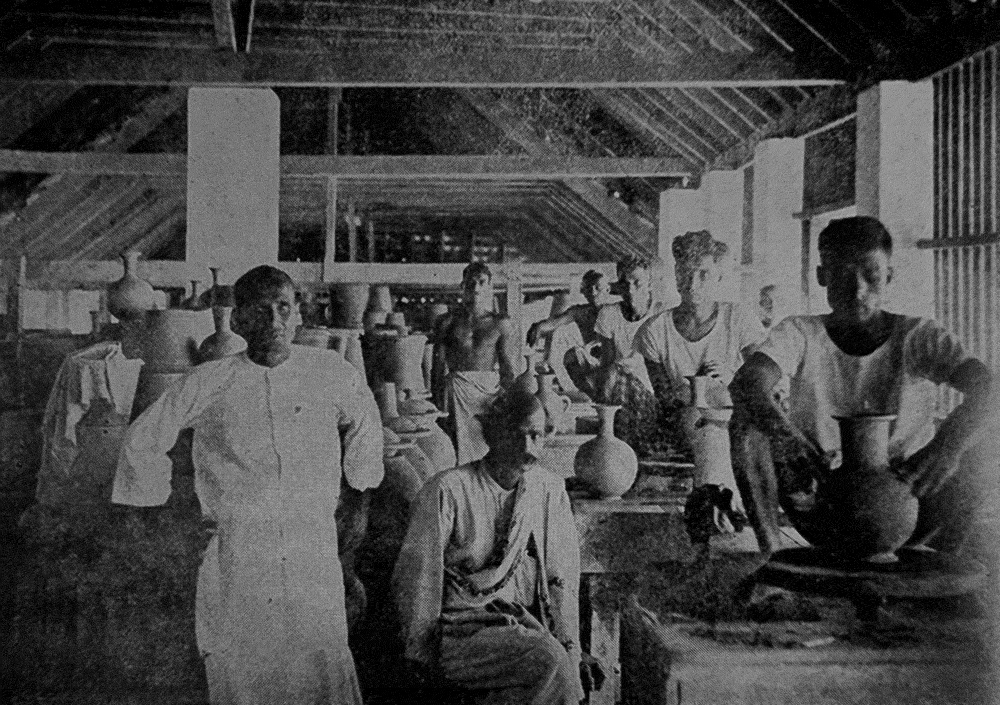
The history of the College begins before the institution’s establishment itself. In nineteenth-century Travancore, artistic production was sustained by the royal court through guilds and workshops whose knowledge passed through family lineage and professional training rather than formal schooling. Ivory carving, metalwork, wood carving, koftgari, weaving, pottery, and silversmithing constituted a craft economy with its own hierarchies of mastery, its own division of labour, and its own relation to patronage. The court determined the occasions, the materials, and the iconographic range within which artisans worked.
The skill of these workshops entered a wider arena of visibility through Travancore's participation in the Great Exhibition of 1851 at the Crystal Palace in London. The centrepiece of that submission was an ivory throne and footstool commissioned by Maharaja Uthram Thirunal Marthanda Varma, densely carved with plaques combining Travancore motifs and European forms. It became one of the most closely studied exhibits of the Indian section and was presented to Queen Victoria after the close of the Exhibition, entering the imperial interiors as a chair of state. The recognition carried consequences: an object made within a court-supported craft system had been evaluated in an imperial arena of display and judgement, and the question of how such craft knowledge might be formalised and taught came into focus for Travancore's administration. That question persisted alongside the pressure of subsequent participation in Delhi Durbars and international exhibitions through the century's later decades.
The institutional answer was the establishment of formal art instruction in 1881. Under Visakham Thirunal Rama Varma, K. Narayana Iyer was deputed to Madras to study the School of Arts there, and on his return structured teaching began in Thiruvananthapuram. The school consolidated over the following years and was housed by 1888 in the purpose-built premises at Palayam, under the reign of Moolam Thirunal Rama Varma, and came to be known as H.H. The Maharaja's School of Arts, Travancore. The pedagogical framework it adopted was the South Kensington model then dominant across British art schools, a system that subordinated invention to drawing discipline, ornamental design, and the accurate reproduction of approved models.
Through the late nineteenth and early twentieth centuries, the school reorganised inherited craft within a colonial curriculum. Traditional practices remained in the teaching, but their transmission and meaning were altered by the regulatory academic frame. The departments of the period, spanning painting, modelling, textile, wood carving, pottery, rattan work, Ivory carving and silverwork, mapped the range of the Travancore craft economy onto the grid of an industrial school. The institution moved through a sequence of administrative homes, each reshaping its character. It was established under the Education Department of the princely state, transferred to the Industries Department in the 1930s, and after the formation of Kerala state in 1956 was brought under the Directorate of Technical Education.
That placement had a long consequence: for decades the institution remained closer to an industrial and vocational training centre than to a university-level art college, its certificates directed toward employment in the trades rather than the formation of artists.
By the late 1960s a student movement had formed to contest this condition. The demands were direct: degree-level recognition, curricular reform, qualified faculty, adequate studios and library provision, and parity with the national art institutions that had emerged at Baroda, Santiniketan, and Delhi. These protests were not peripheral to the institution's history. They constituted the mechanism through which it changed, compelling the state to establish committees on the future of fine arts education in Kerala and connecting the local struggle to a broader national debate about the purposes of art schools in an independent country. Consequently, the Government constituted a committee for the reorganization of Fine Arts education in Kerala.
The committee chaired by Malayattoor Ramakrishnan, with members including M.V. Devan and P.T. Bhaskara Panicker, submitted its report in 1973 and recommended restructuring the institution as the College of Fine Arts, Kerala. The College was upgraded in 1975 and formally inaugurated in 1976 by the then Chief Minister of Kerala Sri. C Achuthamenon. BFA courses in painting, sculpture, and applied art, affiliated to the University of Kerala, followed before the decade's close. The transition from diploma to degree reconceived the student as an artist capable of sustained independent inquiry rather than a trained hand serving the requirements of an industry.
The history of the College does not resolve into a linear progress narrative. It is constituted by royal patronage, colonial pedagogy, administrative containment, student dissent, and continuing reform. The institution now committed to creative freedom and contemporary practice is continuous with the institution that once taught design-copying in the service of the colonial economy. The College approaches that history as a critical resource rather than a celebratory inheritance.
Heritage Architecture
The campus and its built memory.

The campus carries the architectural record of several historical periods, and its buildings are documents of the institution's changing purpose. The principal heritage building, the structure at Palayam, is among the most significant examples of late-nineteenth-century institutional architecture in Thiruvananthapuram. A two-storey colonial structure in which a vernacular sensibility is absorbed into a Victorian Gothic vocabulary, characteristic of the princely-state building programme of the period.
The Gothic vocabulary is deployed with precision. Pointed arches over openings and doors, intricately worked grilles, painted and ornamented handrails, cast-iron entrance gates. The upper floor carries a sloping tiled roof with richly carved wooden gables. High ceilings, long verandahs, and generous natural light and ventilation address climate and use as much as aesthetic convention. The building's distinctive character derives from the superimposition of a European ecclesiastical idiom onto the secular purpose of an art school, inflected throughout by the craft traditions that gave the institution its founding rationale.
The Sculpture Department complex represents an older stratum of the campus. The structure is approximately a century and a half in age and first functioned as the textile department, where weaving, spinning, and allied trades were taught. An adjoining hall served craft instruction in rattan, koftgari, and smithery. The high roof and distinct material zones that characterise the building were determined by the physical demands of workshop practice rather than by architectural convention. The early industrial-school character of the institution is more legible here than anywhere else on the campus, and the complex constitutes an architectural document of the institution's original purposes.
The College is committed to the documentation, conservation, and critical reuse of its built heritage, ensuring that future development serves present academic requirements without erasing the architectural character that makes the campus a primary source for the history of art education in Kerala.
Archives
Building the College Archive
The College is building a digital and physical archive documenting its institutional history: the student movements, curricular changes, exhibitions, faculty contributions, and visual culture it has produced and absorbed across more than a century. The materials survive in scattered custody and uneven condition. Photographs, government orders, committee reports, syllabi, exhibition posters, press cuttings, and oral histories are being systematically gathered and catalogued.
The archive is conceived as a research resource for students, scholars, artists, and the public rather than a static repository. Its scope extends from the Travancore craft guilds and the founding of the School of Arts through the South Kensington curriculum, post-independence reform, and the student movements of the early 1970s to the present programme. An institution that for much of its history taught the reproduction of approved models has particular reason to maintain open access to its records, which constitute the evidence against which any account of its purposes, achievements, and failures must be tested.
The digital archive holds historical photographs and administrative documents, committee reports and recommendations, materials from the student protests and the institutional reforms that followed, photographic documentation of exhibitions and academic events, and oral history interviews with alumni, former faculty, and staff. The archive supports exhibitions, research publications, and classroom teaching, and is open to collaborative engagement with researchers, alumni, cultural institutions, and the public.