

About
The College of Fine Arts Kerala, Thiruvananthapuram, is one of the oldest institutions for art education in the country.

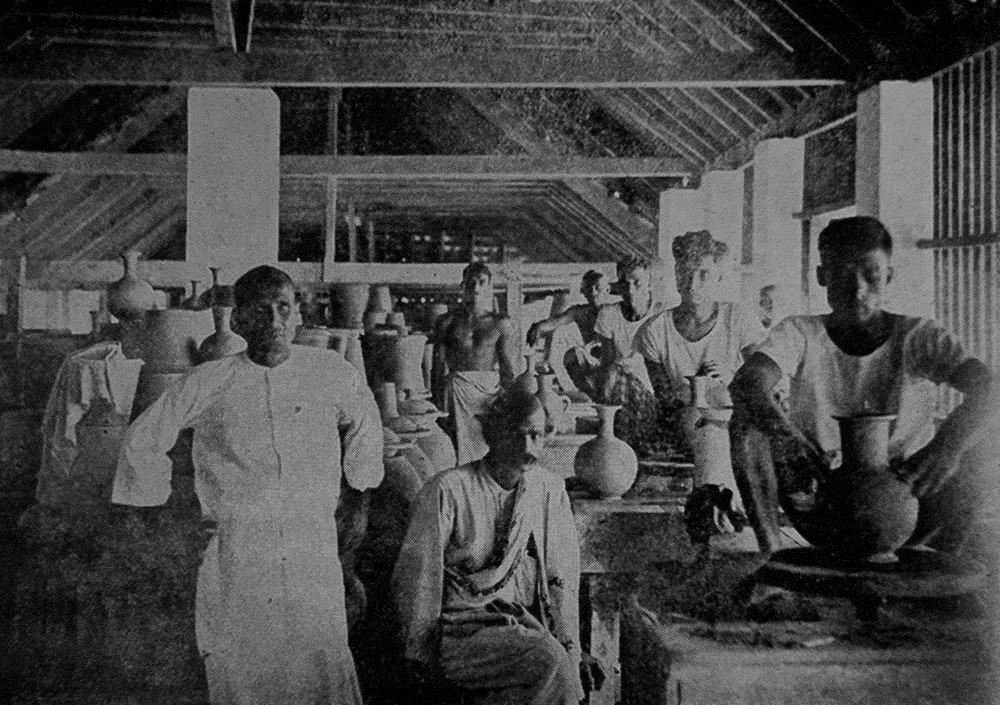
The origins lie in the craft economy of nineteenth-century Travancore. The institution that it became grew through student agitation, administrative reform, and a sustained argument about the purpose of art education extending over more than a century. The College now conducts degree programmes in painting, sculpture, and applied art, alongside postgraduate courses in painting and sculpture, and an active programme of exhibitions, public events, and critical discourse.
Its commitments are to creative freedom, critical rigour, and the understanding of artistic practice as a field of public consequence. The campus, located in the heart of Thiruvananthapuram, centred on its Victorian Gothic heritage building of more than a century old, houses the College's Painting department, and an adjacent building houses a library of over six thousand titles, a developing institutional archive, and a gallery serving both academic and public exhibition programmes. The College is affiliated to the University of Kerala and administered by the Directorate of Technical Education, Government of Kerala.
Vision
The College of Fine Arts Kerala fosters creative freedom, critical inquiry, and social engagement through art, design, and research. It encourages experimentation, rigorous thinking, and meaningful dialogue between practice and the world, preparing culturally aware practitioners who contribute thoughtfully to society.

The College of Fine Arts Kerala understands art education as a field of creative freedom, critical inquiry, and public responsibility, and builds its academic programme around that understanding. It is committed to progressive, inclusive, secular, and democratic values, and to the development of artistic practice as a form of serious intellectual and social engagement.
The College supports work that questions inherited conventions, engages directly with social and political reality, and sustains the conditions for genuine experiment. It regards material skill and conceptual rigour as inseparable rather than competing, and individual practice as necessarily in dialogue with the broader critical conversation. Neither the technically accomplished work that forecloses on ideas nor the conceptually ambitious work that has abandoned material intelligence represents the standard the institution holds to.
Research, practice-led inquiry, archival engagement, and contemporary experimentation are central to the institution's academic life. The studio is understood as a site of inquiry no less than of production. The curriculum is held continuous with the world beyond the campus, so that questions of society, politics, ecology, memory, and historical formation enter the work as constitutive elements rather than external references. The College seeks to produce artists, designers, scholars, teachers, and cultural practitioners for whom intellectual and social awareness is integral to their practice rather than incidental to it.
Creative freedom is not an optional condition but the ground of serious art education. The College is committed to maintaining the intellectual and artistic conditions under which doubt, dissent, and experiment remain genuinely possible, and regards that commitment as among its primary institutional responsibilities.
Our History
From the Travancore Craft Economy to a Modern Art College.
Heritage Architecture
The campus and its built memory.
